You open the dashboard Monday morning and CPA has spiked. Your stomach drops. The most dangerous thing to do right now is act first — swap the creative, pause the campaign, cut the budget. If you touch something without knowing the cause, it won't actually get fixed, and you'll never know what worked. Today let's map out the order to check things in when performance suddenly craters.
Diagnosis isn't about finding the culprit — it's about narrowing the scope
There are dozens of reasons performance can drop: creative, targeting, competition, seasonality, landing page, tracking, budget allocation… If you dig into every single one, you'll burn a whole day.
That's why order matters. You work from the top, ruling out big chunks at each step, until only one or two suspects are left.
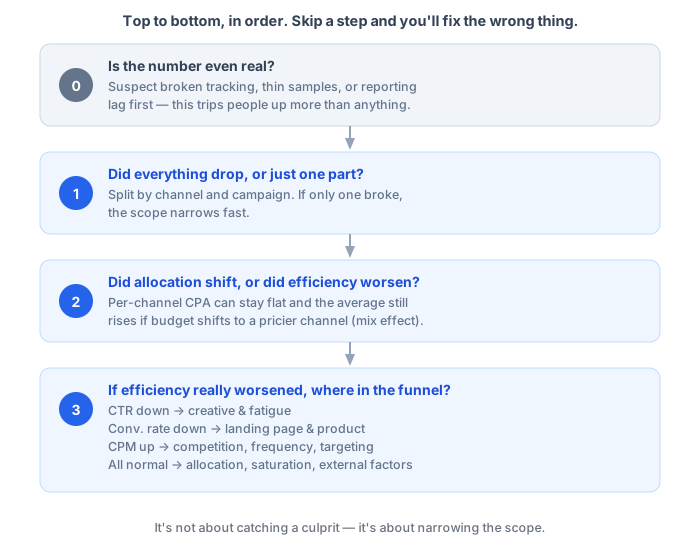
Let's go through it in this order.
Step 0. Is that number even real?
The first thing to suspect is the data itself. Skipping this step is how people waste hours chasing a ghost.
Tracking might be broken. If there was a dev deployment, the conversion pixel could have been dropped. In this case, actual performance is fine — the number just isn't being captured. If you pause ads here, you're killing a perfectly healthy campaign.
The data might not be fully in yet. Conversion lag or reporting delay can leave the last few days looking thin. Looking at yesterday's half-loaded numbers this morning and concluding "we're doomed" is a classic illusion.
The sample might be too small. The CPA of a campaign with 5 conversions can swing wildly in a single day. This is the zone where you genuinely can't tell a real drop from noise. Here, "it's too early to call it" is the correct answer. Forcing a conclusion out of thin data usually leads to the wrong action.
The check is simple: if conversions suddenly dropped to near zero, suspect tracking first. If it's just moderately worse, move to the next step.
Step 1. Did everything drop, or just one part?
Now it's time to split things apart. Break it down by channel, then by campaign.
If only one channel collapsed, your scope just narrowed dramatically — you only need to look inside that channel. But if every channel got uniformly worse, look outside the ad account: a dead landing page, an out-of-stock item, a price change, or the season ending.
This one split cuts your search area in half or more. That's why the first move in any diagnosis is always splitting things apart.
Step 2. Did allocation shift, or did efficiency actually get worse?
This is the step people miss most often.
A higher blended CPA doesn't necessarily mean the channels got worse. Even if each channel's own CPA stayed exactly the same, simply shifting budget share toward a more expensive channel will push the overall average up. This is called the mix effect.
If that's what happened, overhauling your creative? Wasted effort — the channel was fine. The problem was allocation. We covered how to split a rising CPA into an allocation component and an efficiency component in how to lower CPA.
If you're running automated bidding, be especially suspicious of this — the algorithm may have shifted budget on its own, changing the mix underneath you.
Step 3. If efficiency really did get worse, where in the funnel?
You've split things apart and confirmed a specific channel's efficiency genuinely declined. Now trace down the funnel to see which metric actually moved.
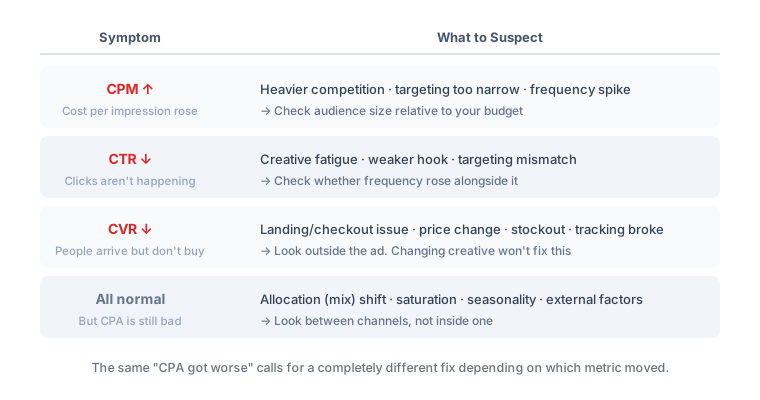
CTR dropped → Look at your creative. But first, check whether frequency rose alongside it. If frequency also went up, creative fatigue is likely. If frequency stayed flat and only CTR dropped, it's probably something else — increased competition or a targeting change.
Conversion rate dropped → It's outside the ad itself. Landing page, checkout flow, pricing, inventory. Changing creative will never fix this.
CPM rose → Your cost per impression jumped. Either competition intensified, or your targeting is too narrow and you're bidding against the same people over and over. Time to check your audience size.
Everything looks normal but CPA is still bad → Look between channels, not inside one. Allocation shifted, you've hit saturation, or it's a seasonal factor.
One more pause once you think you've found it
By this point, you usually land on an "ah, this is it" moment. But take one more beat before you act.
Multiple things can change at the same time. Your creative was aging, a competitor launched a promo, and the season ended — all at once. Observation alone can't tell you how much each one actually contributed. Timing overlapping doesn't mean it's the cause. (This is exactly why it matters not to mix up correlation and causation.)
So when you take action, change one thing at a time. If you swap creative, widen targeting, and cut budget all at once, even if things recover you'll never know what actually worked. Next time this happens, you'll be back to square one.
What to do today
Even if you're not in the middle of a drop right now, write down the diagnosis order somewhere. Four lines, step 0 through step 3, is enough.
Under pressure, people skip steps. With your heart racing, you'll reach for the creative first. Having the order written down ahead of time stops you from doing that. That one habit alone saves you days of wasted effort.
Wrapping up
Diagnosing a sudden drop isn't about catching a culprit — it's about narrowing the scope. Is the number real → what collapsed → allocation or efficiency → where in the funnel. Follow this order and most drops get resolved within half a day.
And when you fix something, fix one thing at a time. That's how you catch it even faster next time.