Most of us decide when to swap creative by gut feel — "this one's been running a while, hasn't it?" But pull a healthy creative too early and you're leaving performance on the table. Pull it too late and you're bleeding budget the whole time. Today, let's look at how to judge creative fatigue with numbers instead of a feeling. Two metrics are all you need.
First, what creative fatigue actually is
Show the same creative to the same person over and over, and their response cools off. An ad that caught the eye the first time gets scrolled past the third time. That's creative fatigue.
Here's the important part: it's not that the creative is bad. The creative hasn't changed — the viewer is just tired of it. So there's no need to beat yourself up wondering "did I make a bad creative?" Even a great creative will eventually fatigue if you run it long enough.
The signal shows up as a "scissors" shape
Two metrics are enough to spot fatigue: CTR and frequency. Frequency is the average number of times one person has seen this ad.
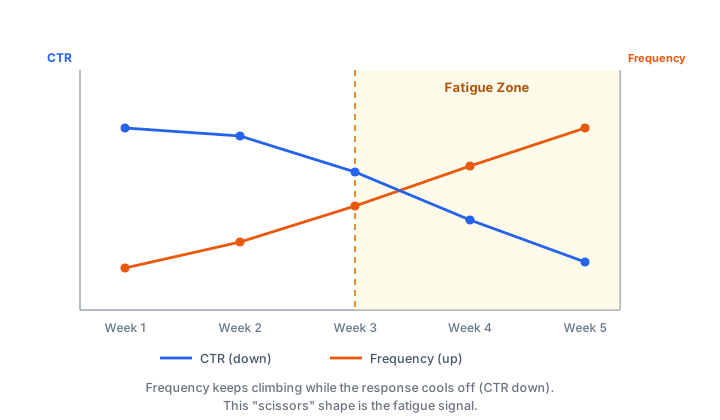
Frequency goes up while CTR goes down. The two lines pull apart into something that looks like open scissors. That's the classic fatigue signature.
Here's why this combination matters. Rising frequency means you're not reaching new people anymore — you're showing the ad again to people who've already seen it. Your audience is wearing out. Once CTR drops on top of that, it means people simply aren't responding to the repeat exposure.
You can't judge from either metric alone. CTR alone won't tell you why it dropped, and frequency alone won't tell you whether that's actually a problem yet.
But a CTR drop isn't always fatigue
This is where most people get it wrong. Jumping straight from "CTR dropped" to "creative fatigue" is a common misfire.
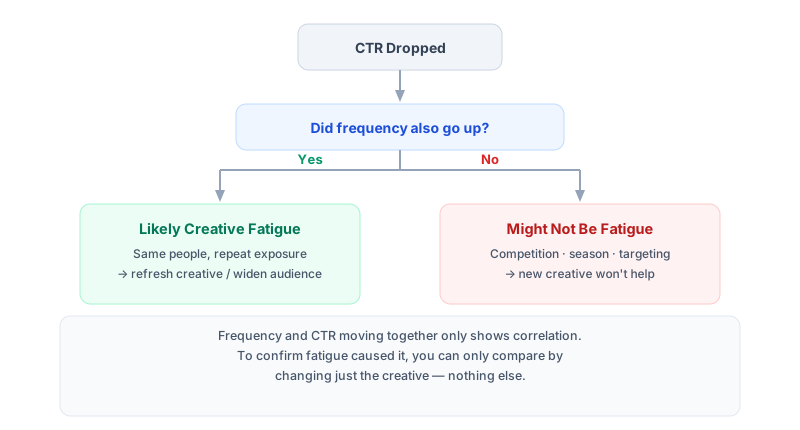
One question splits the two cases: "Did frequency also go up?"
If frequency stayed flat but CTR dropped anyway, it's probably not fatigue. A competitor may have moved into the same placement and intensified the auction, the season may have passed, or someone may have changed the targeting. In these cases, no amount of new creative fixes it — the real cause lies elsewhere.
Let's be honest about what this actually proves
Frequency went up and CTR went down. The fact that these two moved together only establishes correlation. It doesn't confirm that repeat exposure caused the CTR drop.
Something else could have changed during the same window. To actually confirm causation, there's really one way: hold everything else constant and change only the creative, then compare. If CTR recovers after you switch to a new creative, that's when you can say fatigue was the real cause.
Observational data only gets you this far — confirming it requires a comparison. If this distinction feels fuzzy, see our post on correlation vs. causation.
So when should you actually refresh it
If you were hoping for a magic number like "swap at frequency 3," sorry — there isn't one. Thresholds vary by platform, industry, and audience size. Borrowing someone else's benchmark wholesale is actually risky.
Instead, set the threshold from your own account's past patterns. At what frequency did your past creatives usually start turning down, and how many days in did the signal typically show up? That's your threshold.
And one more principle: watch for the point where CTR starts turning down, not the point where it bottoms out. If you wait until it's completely dead, you've already burned weeks of budget. Spot the trend turning and get the next creative ready ahead of time.
Before you refresh creative, check your audience too
One more thing. When the fatigue signal shows up, the answer isn't always "new creative."
The root reason frequency is climbing might be that your audience is too narrow, and everyone who was going to see it already has. In that case, even a brand-new creative just repeats the same problem a few days later — you're still showing it to the same people.
So creative refresh and audience expansion need to be considered together. We'll pick up exactly which one is the answer in narrow vs. broad targeting.
Try this today
Pick the oldest creative you're currently running, and lay CTR and frequency side by side, week by week. Two rows in a spreadsheet is all it takes.
If the two lines are pulling apart, it's time to get the next creative ready. If frequency is flat but CTR alone dropped, look somewhere other than the creative. This five-minute check turns "a feeling" into "a judgment call."
Wrap-up
Creative swaps should be decided by signal, not by gut. Plot CTR and frequency — just two lines — and most of the call becomes obvious. And to confirm whether the signal is really fatigue, the proper move is to test by changing only the creative.
If drawing these trends by hand every time is a hassle, just upload a CSV to the creative fatigue check in our free tool. Whatever you upload is processed only in your browser and never leaves it.