"Narrow targeting is more accurate" and "broad is the answer these days" both circulate at the same time. Both are true, and both are half-true. The right answer changes with the situation, so this isn't something to memorize — it's something to learn to judge. Today, let's look at what to check before you decide.
Compare observed reach and response
Let's start with the tradeoff. Narrowing your targeting gives you something and takes something away at the same time.
Narrowing limits eligible reach, but does not guarantee higher conversion or more expensive CPM. Check whether the selected traits represent buying intent, alongside auction conditions and creative response.
Broadening expands the eligible pool. The algorithm still selects delivery, so measure the actual direction of CPM and conversion changes.
Here's the key point: CPA is the outcome of all four of these interacting together. If you look only at conversion rate and conclude "narrower is better," you're missing the CPM increase. If you look only at CPM and conclude "broader is better," you're missing the conversion rate drop. You need to judge by final CPA, not by any single metric in isolation.
Half the CPM can still mean a higher CPA
This arithmetic example assumes one million impressions per audience. It is neither a benchmark nor observed broad-targeting performance. CVR means conversions per click; view-through conversions are excluded.
| Metric | Narrow | Broad |
|---|---|---|
| CPM | $12 | $6 |
| CTR | 2% | 1% |
| Click-to-conversion rate | 5% | 4% |
| Cost | $12,000 | $6,000 |
| Conversions | 1,000 | 400 |
| CPA | $12 | $15 |
With aligned scope, CPA = CPM ÷ (1,000 × CTR × CVR). Cheaper impressions can still lead to a higher CPA when click and conversion rates differ. The reverse can also happen; audience width does not determine the winner.
To evaluate a targeting change, align budget, creative, optimization event and conversion maturity, and record the comparison conditions. Use a randomized experiment where feasible. Ordinary campaign differences do not establish a causal targeting effect. Check the cost, impressions, clicks and conversions in the Operations dashboard.
Track reach and frequency when scaling
This is where things fall apart most often in practice — a narrow target that's been performing well suddenly collapses in efficiency the moment you increase its budget.
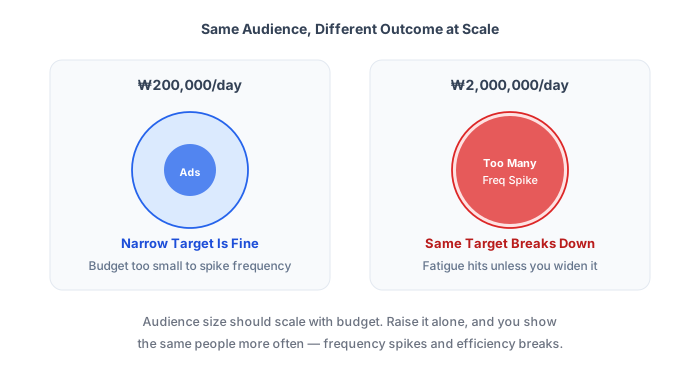
The diagram illustrates a possible increase in repeated exposure. A larger budget for a limited audience can increase repetition, but inspect actual reach and frequency distributions. Frequency alone does not establish creative fatigue; check CTR, cost and mature conversions as well.
Audience size does not need to increase in a fixed proportion to budget. Efficiency may hold after an increase; evaluate marginal results, reach and frequency after a bounded change. Changing targeting and creative at the same time makes the result harder to interpret.
So what should you actually check
Three things, roughly, and the picture becomes clear.
What is frequency doing right now? Rising frequency calls for reviewing repeated exposure alongside the observation window, frequency distribution, CTR and conversions. A low average does not guarantee room to scale.
Are you planning to raise budget? Choose which hypothesis to evaluate first: scaling or expansion. Define the observation window and stopping conditions, and avoid changing several settings at once.
What is the volume and quality of the conversion signal? With sparse conversions, check event definitions, missing tracking and conversion delay as well as audience width. Expansion may add observations, but does not guarantee better learning or customer acquisition efficiency.
Why you shouldn't take a narrow target's great CPA at face value
One thing worth flagging directly. Very narrow targets — retargeting being the classic case — often show dazzling CPA numbers. But taking that number at face value is risky.
Some prior visitors may return without advertising. An attribution report cannot identify that share, so a good retargeting CPA does not imply an equally strong incremental effect.
Investigate that difference with a valid incrementality design. Audience width alone does not determine the size of the gap between attributed and incremental performance.
The answer isn't one or the other — it's a mix
In practice, this is usually how it plays out.
Broad and narrow targeting can coexist, but results must establish which contributes scale or efficiency. A lookalike audience can also vary in width depending on its settings and source population.
Review marginal efficiency, overlapping reach and new-customer outcomes when considering budget reallocation. Increasing the broad share is not a goal by itself.
Try this today
Line up your current campaigns by targeting width, and write down the frequency for each one alongside it.
Review mature conversions and marginal efficiency where frequency rises. If expansion is needed, avoid mixing a budget and targeting change at once; define the hypothesis, step size and comparison window.
If the broad-versus-narrow call comes down to how much learning signal you have, the ad learning phase covers when learning ends and what resets it.
Wrap-up
Narrow versus broad isn't a matter of preference. Decide based on what frequency looks like right now, whether you're about to raise budget, and whether you have enough data. And it's worth second-guessing a narrow target's great-looking CPA, at least once.
Figuring out whether a CPA collapse is really about targeting, creative, or budget allocation is a separate question — pick that up in ad performance diagnosis.