"What do I need to learn to become a performance marketer?" A lot of answers to this question start by rattling off tool names — Meta Ads Manager, GA4, SQL, a tag manager… but tools aren't skills. They're just instruments. Today, instead of a tool list, let's map this out as a growth sequence — the order skills actually stack in. Once you know which level you're standing on, it's obvious what to learn next.
Knowing a tool and knowing how to decide are two different things
It's common to see someone who's fluent in an ads manager but picks budget splits by gut feel. The reverse happens too — someone who's great with statistics but has never touched a live account. Both are only half the picture.
Performance marketing ultimately comes down to "deciding how to get the most out of a limited budget." Tools just support that decision. That's why skills need to be thought of as layers, not a list of software.
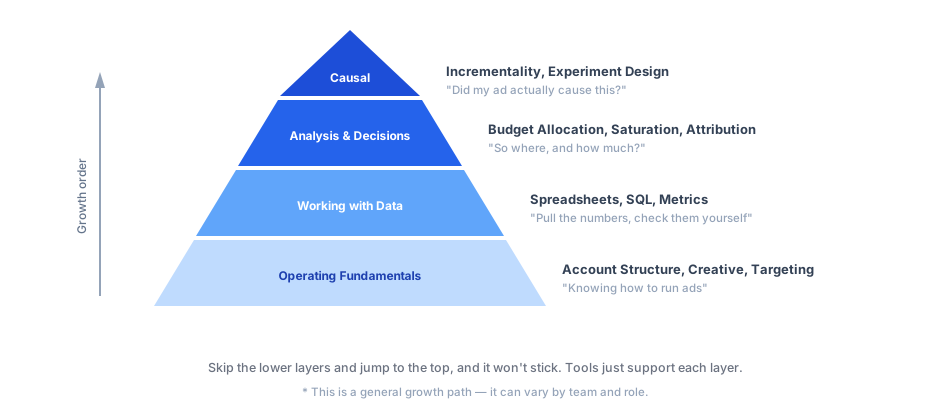
Skip the lower layers and jump straight to the top, and it doesn't stick. I've seen people who dove straight into incrementality or MMM and still couldn't structure a basic account.
Layer 1. Operating Fundamentals — knowing how to actually run ads
How you split accounts and campaigns, how you build creative, how you set up targeting. This is the floor.
You can't learn this from a book — you have to actually run campaigns. You need to try a handful of creatives, feel firsthand why CTR drops, watch CPM spike when you narrow a targeting group. There's no substitute for having actually spent real ad dollars.
What to build here: get comfortable with at least one media ads manager, build and test creative yourself, develop a feel for targeting setup.
The operating layer becomes more concrete with distinct playbooks: Meta Advantage+ App operations, ASO basics, separating retargeting and re-engagement, and creative specs and safe zones.
Layer 2. Working with Data — pulling the numbers yourself
There's a bigger gap than you'd expect between someone who only looks at whatever a dashboard shows, and someone who pulls numbers straight from raw data and double-checks them.
What's needed here isn't anything fancy. Using a spreadsheet properly is a useful starting point — breaking things down by channel and time period with pivot tables, calculating metrics yourself, and going back to the raw data whenever a number looks off. SQL is a big help if your company runs its own database, but you can absolutely start without it.
What to build here: slicing data with pivots and formulas, calculating metrics yourself to double-check them, and (if possible) basic SQL.
Layer 3. Analysis and Decision-Making — "so where, and how much"
This is where the real work of a performance marketer begins — not just reading numbers, but using them to make decisions.
The core questions are: how should budget be split across channels? Can I safely put more into this channel, or is it already saturated? Did CPA rise because a channel got worse, or because the mix of spend shifted?
Surprisingly few people know this layer well, which makes it the layer where people actually differentiate themselves. This is where concepts like marginal utility in marginal-efficiency budget operations and the mix effect in ad performance diagnosis live.
What to build here: the difference between average and marginal (the next won you spend), the concept of saturation and response curves, and decomposing why performance went up or down.
Layer 4. Causal Inference — "did my ad actually cause this result?"
The top layer. This is the level where you can look at an 800% ROAS on a dashboard and ask, "how much of that would have happened anyway, without the ad?"
This comes last because you can't even think to ask the question without the layers below it. You need to have handled the numbers directly and gotten a few budget calls wrong before "can I actually trust this number?" starts to occur to you.
Incrementality measurement, A/B experiment design, and distinguishing correlation from causation all belong here. Reach this layer, and you go from someone who "reads" data to someone who "verifies" it.
Remember tools by function, not by name
Now, about tools. Memorizing a tool list doesn't get you very far — every company uses something different, and it all changes again in a few years. Instead, knowing which slot a tool fills lets you adapt anywhere you go.
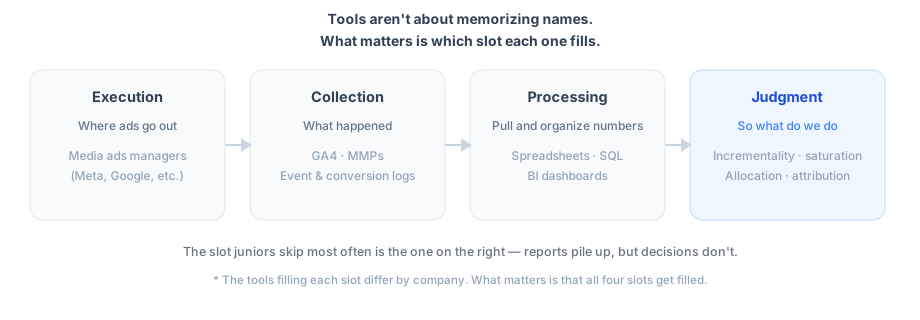
Four slots: execution, collection, processing, judgment. Switch jobs and the tools change, but if you can say "oh, this is the collection slot," you adapt fast.
And the slot juniors skip most often is that last one on the right — judgment. They execute, collect, and get things organized in a sheet, and then stop there. Reports pile up, but "so what should we actually do" never comes out. Filling that slot is what actually separates skill levels.
So where should you start learning
Figure out which layer you're currently standing on, and start there.
Haven't run ads yourself yet — start at layer 1. Run something small yourself, even at a tiny budget. You only really learn once you watch your own money get spent.
Running ads but never touch a spreadsheet — that's layer 2. Don't just take whatever number the platform hands you at face value — pull the raw data and calculate it yourself. Something won't match up. That mismatch is your growth moment.
You look at the numbers, but decisions still come from gut feel — that's layer 3. Hold onto "the next won, not the average." That one shift changes a lot of decisions.
You make decisions but never verify them — that's layer 4. Run a single holdout test and your whole view of the numbers changes.
For a hands-on starting order, marketing data analysis begins from the data you already have, and what remains after automation is in the AI-era performance marketer.
Wrap-up
Performance marketer skill isn't a list of tools — it's a stack of layers: knowing how to run ads, how to pull numbers, how to decide, and how to verify. Fewer people make it to the top, which is exactly why the top pays more.
If layers 3 and 4 have you curious, try uploading a CSV to one of our free tools and watch how calculations like budget allocation, saturation, and incrementality actually work. No sign-up, no payment — and anything you upload is processed entirely in your browser. There's no better way to get hands-on with these concepts.
And don't rush it. This sequence isn't something you finish in a few months. You need to get enough reps — and enough mistakes — in one layer before the next one really opens up.