You found a campaign with great efficiency. You doubled the budget. But conversions didn't double — CPA just went up instead. Almost every marketer who's ever tried to scale has hit this wall. Today let's look at why this happens, and how to scale without breaking things.
Budget is linear. Performance isn't.
First, the why. We all quietly expect this: "if I spend twice as much, I'll get twice the conversions."
But ads don't work that way.
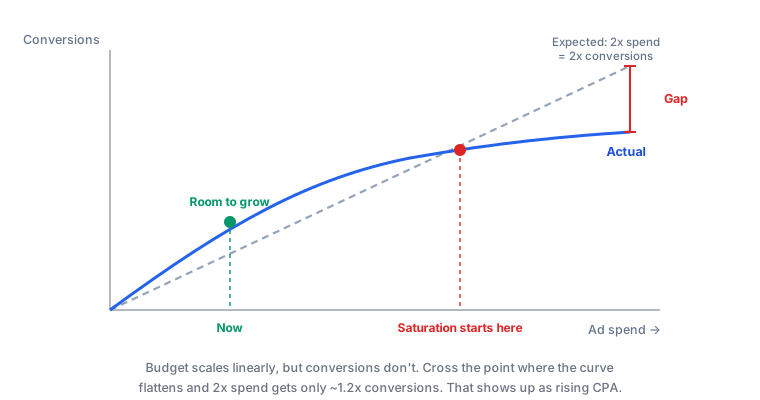
The dashed line is the linear outcome we expect. The solid blue line is what actually happens. They track together at first, but at some point the curve starts to flatten. This is called the response curve, and the flattening part is saturation.
In the saturation zone, spending twice as much only gets you about 1.2x the conversions. The rest just leaks away — and that shows up as a rising CPA.
Here's the key thing to understand: the rising CPA doesn't mean the campaign got worse. The campaign is exactly the same. You just poured more money into a spot that had already been squeezed for everything it had.
The curve flattens because you usually run out of people
Why does it flatten? The root cause is usually you've already reached everyone worth reaching.
If your audience size stays the same but your budget keeps growing, that extra money doesn't go toward new people — it goes toward showing the same ad to the same people again. Frequency climbs. And that's where the domino starts.
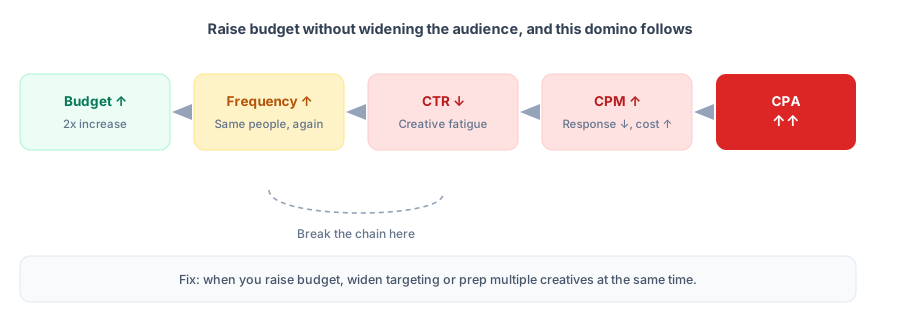
Budget goes up → frequency goes up → people who've seen the same creative repeatedly stop responding, so CTR drops → with lower response, the platform has no reason to keep your cost-per-impression low, so CPM rises → CPA falls apart.
That's why when scaling breaks, several metrics usually get worse at the same time. If only one metric worsened, it's more likely something else entirely.
So don't raise the budget alone
This is where the fix comes in. When you raise budget, don't raise it by itself. A few things need to move together with it.
Widen your targeting at the same time. This gives the money somewhere new to go. If budget doubles but the audience stays the same, frequency doubles too. We covered which direction to widen in our audience size post.
Prep multiple creatives. Rising frequency is somewhat unavoidable, but with several creatives in rotation, the same person sees something different each time, which delays fatigue.
Don't jump the budget all at once. Raise it 20-30% at a time and watch CPA. If it holds, raise it again. Doubling in one jump means you miss exactly where the curve starts to flatten. Platform algorithms also need time to relearn after a sudden budget change, so performance can wobble during that window too.
Sometimes it's faster to move the money to where there's still room
Here's a mindset shift. Instead of forcing more money into an already-saturated channel, it's often better to send that money to a different channel that still has room.
The thing to focus on isn't the average — it's the "next dollar." Channel A might have the best average ROAS at 480%, but if it's saturated, the efficiency of the next chunk of budget you add is much lower. Meanwhile, Channel B might have a lower average but sit in a zone with room to grow — so that same money earns more there.
This marginal-utility view is the core of scaling. We went into this in more depth in our budget allocation post and our ROAS improvement post.
Being honest: was it really a scaling problem?
CPA went up, and you'd also raised the budget. So it must be scaling, right? Not necessarily.
Competition could have intensified at the same time, the season could have ended, or the creative could have simply aged out. Budget going up and CPA going up happening together only tells you there's a correlation. To actually attribute it to scaling, you'd need to see whether CPA comes back down when you roll the budget back.
If you want to be sure, there's a way to test it: raise the budget in only some regions or some campaigns, and leave the rest unchanged. The difference between the two is the scaling effect. This kind of holdout method can separate what pure observation can't.
What to do today
Before you raise budget, check just one thing: where is this campaign's frequency right now?
If frequency is already trending up, raising the budget will kick off the domino the moment you do it. Widen targeting or prep more creative first. Just changing the order can save you days of wasted budget.
And when you do raise it, do it in 20-30% steps, watching for exactly where the curve starts to flatten.
Wrapping up
Scaling breaks not because the campaign got worse, but because you crossed the point where the curve flattens. Raise the budget alone, and that money goes toward showing the same people your ad more often instead of reaching new ones — and that's where the domino starts.
If manually calculating how much room each channel still has feels tedious, try uploading your media report CSV to the saturation diagnosis in our free tool. It shows you exactly where you sit on the response curve. Everything you upload is processed in your browser only — nothing gets sent to a server.
If you raised the budget and things already broke, work backward with our drop-diagnosis order to narrow down the cause first.