In one line
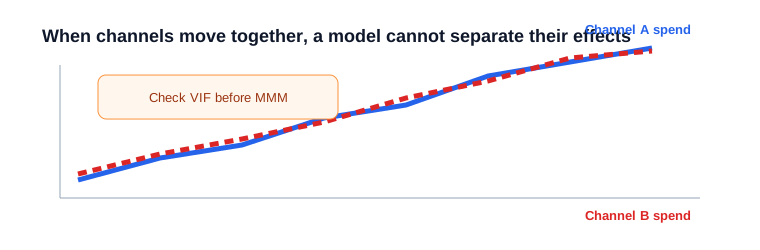
When independent variables in a regression — spend across several channels, say — always rise and fall together, the model cannot reliably separate which one produced the result. That state is multicollinearity.
Why it matters
This is a common trap in marketing data. If you always scale two channels together, revenue going up can't be cleanly attributed to one or the other — coefficients become unstable and can even flip sign. It's especially common in Marketing Mix Modeling, where channel-level contribution is being regressed.
How to spot it
- Check pairwise correlation between channels before modeling.
- Check VIF (variance inflation factor). A VIF of 5+ is commonly a warning and 10+ a severe signal. A low VIF does not prove causality; a high VIF means the channel coefficients have weak standalone interpretation.
- Coefficients with counterintuitive signs or unusually large standard errors are a warning sign.
- The real fix isn't statistical — it's data design: you need periods where channels moved independently for the model to tell them apart.
What to do before MMM
When VIF is high, do not force a channel-contribution answer by changing MMM options. First create periods where the linked channels move independently: a one-channel budget change, a regional experiment, or a holdout. Use the VIF Multicollinearity Check on a channel-spend CSV before modeling.
Go deeper
See how multicollinearity distorts MMM results in What is MMM.