Uplift meaning in advertising
Uplift generally means an increase. In an advertising experiment, uplift is the outcome difference between a group assigned to advertising and a control assigned to have that advertising withheld.
Interpreting this difference as incremental ad impact requires checking random assignment, aligned observation windows and interference between groups. A sales increase after launching ads alone does not establish incremental ad impact.
Absolute uplift = exposed conversion rate − holdout conversion rate
Relative uplift = absolute uplift ÷ holdout conversion rate
Incremental conversions = absolute uplift × addressable audience
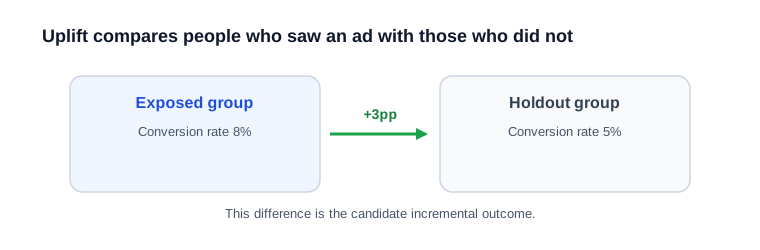
At 8% for treatment and 5% for the holdout, absolute uplift is 3 percentage points and relative uplift is 3pp ÷ 5% = 60%. Absolute uses pp, relative uses %, so the same test produces different numbers. The examples below are hypothetical calculations, not benchmarks or observed campaign results.
Incrementality sits one layer above. Uplift is the difference itself; incrementality asks whether that difference may be credited to advertising at all. Without random assignment or an appropriate quasi-experimental design, the difference alone does not establish incremental ad impact.
Why it matters
Not every conversion in an exposed group is caused by the ad — some of those people (brand searchers, repeat buyers) would have converted regardless. Uplift isolates the piece that's genuinely incremental.
The standard way to measure it is a holdout test: randomly split users into an exposed group and a holdout group that sees no ads, then compare conversion rates.
Why CPA/ROAS alone isn't enough
CPA and ROAS relate cost to outcomes counted under an attribution rule. They do not establish whether advertising caused those outcomes. Even a near-zero uplift point estimate cannot establish a small effect without considering its uncertainty.
How is uplift calculated?
Start with the conversion-rate difference between a randomized exposed group and holdout group. If the exposed group converts at 8% and the holdout at 5%, absolute uplift is 3 percentage points, while relative uplift is (8%−5%)÷5%=60%. Those are different units and should be labelled as pp and % in a report.
| Metric | Calculation | Example |
|---|---|---|
| Absolute uplift | Exposed rate − holdout rate | 3pp |
| Relative uplift | Absolute gap ÷ holdout rate | 60% |
| Incremental conversions | Absolute uplift × exposed population | Depends on population |
If assignment was not randomized, or the groups differ in audience or timing, that difference alone is not proof of ad impact. Use the Incrementality Analysis tool to choose a holdout, launch, or shutdown method that matches your data.
The same 3pp can support different decisions
Eight versus five conversions in groups of 100 gives a 3pp difference. So does 800 versus 500 in groups of 10,000. Their uncertainty is not the same. Keep assigned population, converted population and observation window for each group, rather than saving only percentages.
Use the assigned population defined by the analysis design, not a subset selected afterward because they actually saw an ad. Selecting on actual exposure after randomization can introduce selection bias. When the holdout rate is zero, relative uplift is undefined; do not report it as 0% or infinite performance.
Go deeper
See how to run a holdout test to measure uplift in Measuring Incrementality.