Auto-bidding sets the bid. The algorithm finds the audience. Automated campaigns even pick the placement and creative combination. AI writes the copy and generates the images. So doesn't it feel like everything a marketer used to do is disappearing, one task at a time? Most of us have felt that anxiety at some point.
Short answer: the work isn't disappearing — the center of gravity is shifting. From operating to judging. Today let's get concrete about what that means, and what you actually need to prepare for.
What machines really did take over
Let's be honest first. What automation took over, it really took over. It's not coming back.
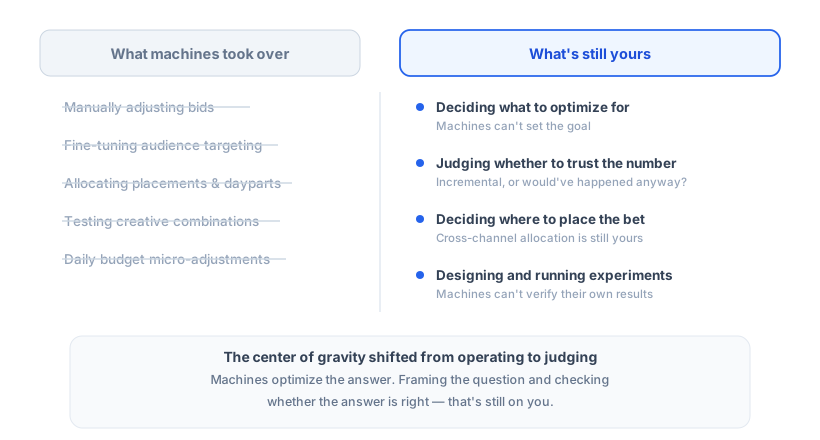
Manually adjusting bids, fine-tuning audience segments by hand, micro-tuning budget by placement — machines are simply much better at this than people. You can't out-compute something running millions of calculations per second.
Honestly, there was a time when this kind of manipulation skill counted as "ability." Being good at operating the ads manager was the job. That era is fading. Better to accept it and move on.
But here's the interesting part. The more the machine takes over operating, the more valuable the non-operating work becomes.
Are you still covering what automation can't?
Three responsibilities to retain under automation
AI can assist with these tasks. That does not automatically settle whether the goal, validation design and business context are appropriate. This is an operating responsibility, not a claim of permanent technological impossibility.
Let's go through them one by one.
1. Check whether the goal fits the business
The algorithm optimizes the goal you give it. That's the whole story.
Tell it "optimize for purchases" and it will — very well. But it won't tell you whether purchase is really the right thing to optimize right now. It could be first payment, it could be repeat purchase, or maybe it shouldn't be purchase at all — maybe retention matters more.
Here's why this matters. Give it the wrong goal, and the algorithm will run toward the wrong destination extremely efficiently. And it'll work very hard doing it.
A common example: you set new installs as the goal. Installs explode — and those users all churn within two days. The algorithm did its job perfectly. It found exactly the "people likely to install." That just wasn't what you actually wanted. What you wanted was users who stick around.
Machines don't know this difference. Not until we tell them.
So defining the goal becomes the marketer's first job. What counts as real success? That's not data analysis — that's a business judgment call.
2. Separate attributed reporting from lift validation
This is the most important part.
The algorithm reports: "I generated this many conversions." But mixed into that report are people who would have converted even without seeing the ad.
Makes sense if you think about it. The algorithm was trained to find "people with a high probability of converting." So someone who already intended to buy is the best possible target. Show them the ad, the conversion fires, and from the algorithm's perspective, that's a total win.
But that's not a result the ad created. It's just stamping approval on something that was going to happen anyway.
Ordinary attribution reports cannot separate these outcomes. Platform-provided lift experiments also require checks of design, audience and uncertainty; the reporting party alone is not a reason to trust or reject a result.
That's why verification has to happen outside the platform. Compare regions where the ad was off versus on, or hold out exposure for a slice of users. That's incrementality measurement, and it matters more, not less, as automation increases. The more the machine runs on its own, the more you need a human to verify the numbers it hands you.
We covered this same idea in understanding ad machine learning — why you shouldn't take a great CPA at face value even after training finishes cleanly.
3. Check whether business context was actually supplied
The third one is a bit more practical.
The data an algorithm can use depends on its integrations and settings. But the information that changes a decision often lives outside it.
Inventory runs out next week. A competitor launches a new product tomorrow. This segment converts well but costs a fortune in support tickets. This month's margin is thin, so a 300% ROAS still isn't profitable.
Without the relevant integrations, this may not appear in account data. But it's often more important than CPA when deciding whether to scale spend up or down.
So the center of gravity moved to "judgment"
To sum up:
Machines optimize the answer. People define the problem, and check whether the answer is right.
These two used to be tangled together. Adjusting bids and tweaking targeting used to be most of the job. Now that the front half is automated, only the back half is left. And the back half was always the harder half.
Here's why that's good news. Operating skill isn't a competitive advantage — everyone's using the same algorithms. Judgment skill, on the other hand, varies a lot. Looking at the same dashboard, one person says "CPA's up, let's swap the creative," while another says "let's split this into mix effect versus efficiency effect first." That difference becomes a performance difference.
So how should you actually use AI tools
AI tools marketers use these days roughly fall into three types. Each needs a different approach.
Generative AI (copy, image, video generation). It cuts creative production time dramatically. But there's a trap here. Now that you can make lots of creative fast, deciding what to make matters even more. Produce 100 variations in the wrong direction, and all 100 are useless. And with more creative in play, figuring out which one actually works gets harder, not easier. Production got faster. Selection didn't.
Execution AI (auto-bidding, automated campaigns). This is what we covered above. Use it well, but understand how the learning phase works and verify the results.
Summarization AI (auto-generated reports, insight summaries). Convenient, but this is where you need to be most careful. Summaries are good at producing plausible-sounding sentences. Plausible isn't the same as correct. When you see a line like "Channel A is performing well, increase its budget," check whether that's based on the average or the marginal return. Executing a plausible-sounding conclusion without double-checking it is the most common mistake right now.
So what should you actually prepare?
Nothing dramatic. Three things.
A habit of questioning the goal. Ask this once a quarter: "Is what we're optimizing for right now actually the right goal?" If installs increased but revenue did not, check the goal, observation window, acquisition quality and product together.
A habit of verifying the numbers. The number the platform gives you, the conclusion the algorithm reaches, the insight AI summarizes — question and double-check all of them. Especially not mixing up correlation and causation. That's the basic literacy of the automation era.
The ability to design experiments. AI can help design experiments, but assignment, measurement and analysis still need validation. The gap between someone who can run a holdout test and someone who can't is only going to widen.
These three are the top two layers of the performance marketer skill pyramid. The more the bottom layer (operating) gets automated, the more the top layers are worth.
Try this today
Open up the optimization goal on a campaign you're running right now. And ask:
"If the algorithm achieves this goal perfectly, does our business actually get better?"
If you're optimizing for installs but retention is bad, or optimizing for revenue but only your thinnest-margin products are selling — check the connection between the objective and business value, alongside delay, measurement, product and operating conditions.
That one question prevents most automation accidents.
Wrap-up
As the algorithm gets smarter, the marketer's job doesn't disappear. The kind of job changes.
Pressing the button — the machine took that over. But deciding what the goal should be, whether to trust the number, where and how much to bet — that's still on you, and it matters more than ever. The faster the machine runs, the bigger the cost of pointing it in the wrong direction.
So what marketers need to build now isn't a hand that's good with tools — it's an eye that knows when to question a number. No amount of automation is going to take that.