An install CPA can fall while the business still feels unchanged. Installs and sign-ups rise, but very few people return a few days later.
That does not always mean the campaign failed. It can mean you gave the platform a goal that was too easy. When you optimize for installs, automation gets very good at finding people likely to install. It does not automatically find people who will experience your product's value and stay.
The practical move is to find the early action between install and purchase that separates high-quality users from everyone else. That action is an Aha Event. The process for finding candidates in data is covered in Aha Moment analysis.
Not every install is the same
Two users can both count as one install. One leaves after ten seconds; the other uses a core feature and returns later in the week. To the ad platform, both are an install. To the business, they are completely different outcomes.
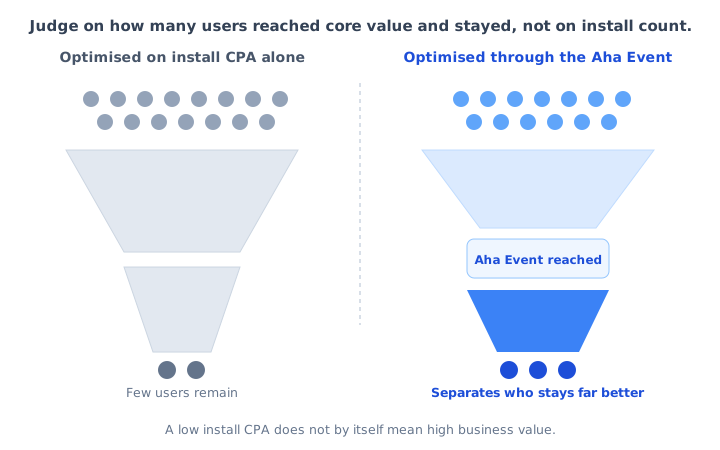
If install CPA is low while Aha Event reach and D7 retention are low too, you may be buying cheap churn. A campaign with a slightly higher install CPA can be better when more users reach the Aha Event and retain. Read cohort retention alongside the average so recent users are not over-read.
Why purchase optimization is not always enough
Purchase is close to the business goal, so it is the right direction when there is enough volume. But early products and smaller accounts often do not generate enough purchases for the platform to learn efficiently.
You need a signal that is closer to business value than an install, but occurs earlier and more often than a purchase.
The Aha Event is that bridge
An Aha Event is the action where a user first experiences your product's core value. For a collaboration tool, it could be creating a project and inviting a teammate. For a content service, it might be saving or subscribing to the first item. For a SaaS product, it can be completing a key workflow with real data.
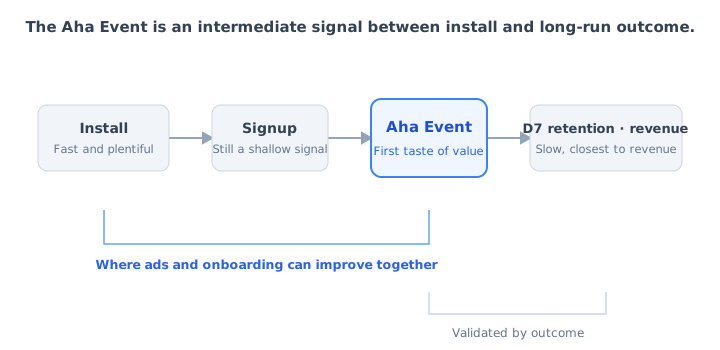
A useful Aha Event is:
- Early — it happens in the first day or first few days.
- Frequent enough — there is enough volume to learn and improve.
- Connected to outcomes — users who complete it show better retention or revenue later.
The question for ads changes from “who will install?” to “who will reach product value quickly?”
Align marketing and product after you find it
The Aha Moment Finder can surface early actions that appear disproportionately among retained users. Evaluate the action together with its timing and frequency, not as an isolated event.
Then improve in two directions at once:
- Onboarding: remove friction on the path to the Aha Event.
- Advertising: align the promise, landing page, and optimization signal with that event.
For example, if the Aha Event is “create a project and invite a teammate,” the ad should make the collaboration promise explicit and the first-run flow should make that sequence effortless.
Treat an Aha Event as a hypothesis first
An Aha Event is a powerful clue, not automatic proof of causation. Highly motivated users may both complete the action and retain longer.
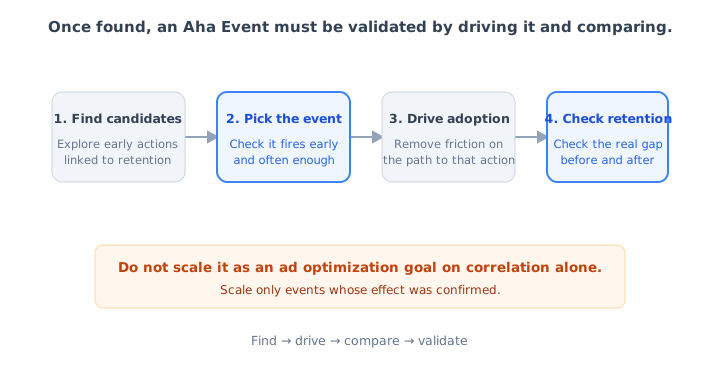
Find a candidate, nudge the action in onboarding or messaging, compare D7 retention and revenue against a control, then scale only events that produce a confirmed lift. See incrementality measurement for how to make that control comparison credible. The process is discover → nudge → compare → validate.
Metrics to add beside install CPA
| Instead of only tracking | Also track |
|---|---|
| Installs | Users who reached the Aha Event |
| Install CPA | Cost per Aha Event |
| Sign-up conversion | Aha Event reach after sign-up |
| Same-day performance | D7 retention, return visits, and revenue |
Automation optimizes the goal you give it. Make that goal a better proxy for durable product value, and ad performance can start contributing to business growth instead of just cheaper installs.
Try this today
Take your current optimization event and count its daily volume. Learning requirements vary by network, campaign type, optimization target, and conversion delay. Check the current platform guidance before changing the event; there is no universal daily cutoff.
Split last quarter's installs into two groups: those that fired your Aha candidate within the window and those that did not. Compare D7 or D30 retention between them. If the curves are not distinguishable, inspect sample support and uncertainty before rejecting the candidate.
Limits of this approach
An Aha event is a correlate of retention, not a proven cause of it. Users who complete an early action may simply have been more motivated to begin with, and optimizing acquisition toward that action can select for people who would have retained anyway.
That distinction matters when you scale. If the event is only a marker of pre-existing intent, bidding harder on it buys the same users at a higher price rather than better users. Where the decision is large, confirm with a holdout in incrementality analysis rather than with the correlation alone.