An Aha Moment is not the one action that retained users happened to do most often. It is a testable statement about which users did which action, how many times, and by when—and whether encouraging that action actually improves long-term retention.
For example, “users who added three friends retained better” may be a useful candidate, but highly motivated users may simply add more friends. Candidate discovery finds association. Product and marketing decisions need a separate causal test.
Aha Moment, Aha Event, and retention
- Retention: an outcome—whether users return later and complete a meaningful action.
- Aha Moment: a behavior, timing, and count combination that may indicate the user experienced product value.
- Aha Event: the measurable event definition used to analyze, share, or optimize toward that moment.
A useful candidate is more specific than “used feature X.” It should read like added three friends within three days of signup, saved five items in the first week, or registered a payment method in the first session. Without timing and count, the finding is hard to operationalize in onboarding.
Start with one row per user
You need user-level data to test candidates.
| Field | Example | Why it matters |
|---|---|---|
user_id |
u10001 |
De-duplicates and connects behavior to outcome |
| 0/1 target | retained_d30=1 |
Defines long-term retention or goal completion |
| Early action counts | invite_d3=3 |
Compares candidate actions and windows |
| Optional segment | channel, OS, country | Detects selection and acquisition bias |
The target does not have to be D30 retention. It may be D7 retention, a first purchase, or paid conversion if it matches the product’s value cycle. Every candidate action must occur before the target window. Using a D30-or-later event to predict D30 retention leaks future information into the analysis.
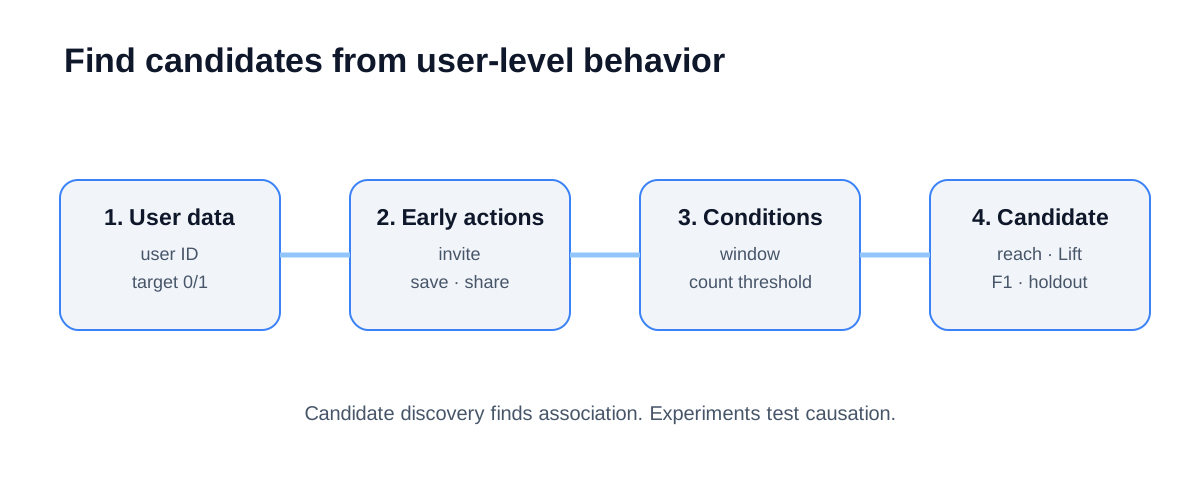
Compare action, time window, and count together
Candidate discovery evaluates:
action × observation window × minimum count
For an invite action, compare one invite within D1, three invites within D3, and five invites within D7. The same behavior can be too early to reflect value or too late to be practical for onboarding.
| Metric | Question it answers | Why it cannot stand alone |
|---|---|---|
| Reach and support | Do enough users meet the condition? | High reach may not separate retainers |
| Lift | How much higher is retention than the overall average? | Rare actions can look exaggerated |
| Precision | Are qualified users likely to retain? | Can favor an impractically narrow group |
| Recall | How many retainers qualify? | Can favor a behavior nearly everyone does |
| F1 | Is there a useful precision-recall balance? | Does not prove causation or feasibility |
F1 is useful because it balances precision and recall. But a high F1 does not make an action a cause of retention. It only makes the action a stronger hypothesis to test.
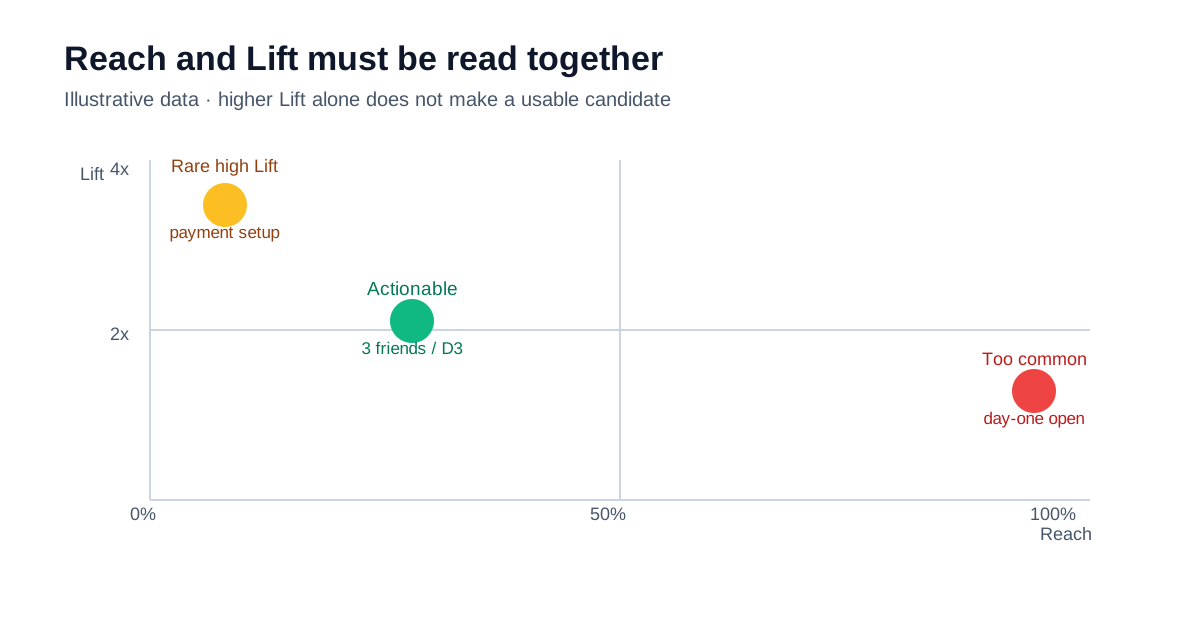
Illustrative example: why Lift alone is not enough
This is illustrative data, with overall D30 retention of 20%. Lift is rounded to one decimal; it is not a benchmark.
| Candidate condition | D30 retention | Lift vs. all users | Reach | Interpretation |
|---|---|---|---|---|
| Add three friends within D3 | 42% | 2.1x | 28% | Strong experiment candidate |
| Save five items in week one | 39% | 2.0x | 8% | Strong signal; check whether reach can increase |
| Open the app on day one | 20% | 1.0x | 94% | Common but weakly discriminative |
| Register payment method in week one | 70% | 3.5x | 1% | Very rare; check support and inducement cost |
Payment registration has the highest Lift, but only 1% of users reach it. Before asking every new user to do it, check whether the sample is large enough, whether the action fits the product journey, and whether its reach can realistically increase. The friend-add condition is usually a better first experiment because signal and reach both matter.
Watch for bias and reverse causation
Be cautious when the candidate is:
- a result behavior available only after the target outcome;
- affected by self-selection, where motivated users do more and retain more;
- concentrated in a high-retention channel, OS, or country;
- based on a small sample with unstable Lift; or
- the single best-looking result from many action-window-count combinations.
Validate that a candidate holds on a separate holdout set. A large gap between training F1 and holdout F1 is a warning that the signal may not generalize.
Move from discovery to an experiment
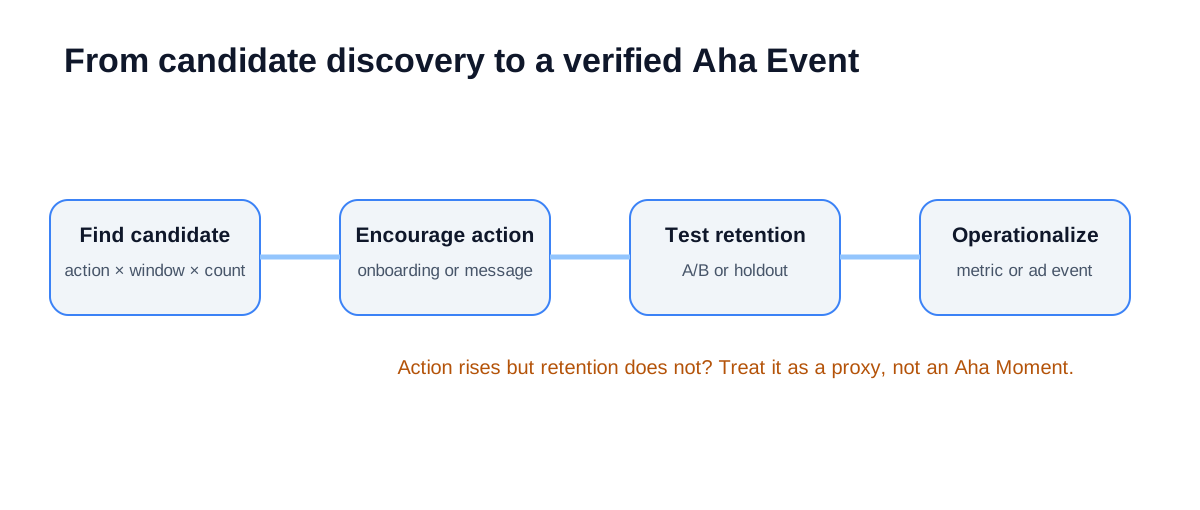
- Define the candidate in one sentence: action, window, count, and target.
- Choose an encouragement: tutorial, empty state, reminder, or message that does not harm the experience.
- Run an experiment: randomly compare qualified-action reach and D7 or D30 retention.
- Interpret both metrics: if the action rises but retention does not, it may be a proxy—not an Aha Moment.
- Operationalize only verified signals as an Aha Event for ad optimization or a shared activation metric.
Before using an event for ad optimization, check signal volume and quality. Very rare events may not provide enough learning signal; very common events may not distinguish downstream value. Continue with event taxonomy design for event quality and A/B testing for causal validation.
Aha Moment checklist
- The retention or conversion target is defined.
- Candidate actions occur before the target window.
- Action, time window, and minimum count are explicit.
- Lift is reviewed with reach, support, precision, recall, and F1.
- Channel, OS, and country bias are checked.
- Training and holdout results are compared.
- Association is not presented as causation.
- An experiment precedes onboarding or ad-optimization rollout.
Conclusion: an Aha Moment is a hypothesis to verify
The goal is not to declare one magical action. It is to turn early behavior linked to retention into a measurable hypothesis, then make better product and marketing decisions through experimentation.
Start with retention cohort analysis to see which users stay. Then use a user-level event CSV and the Aha Moment tool to compare action, window, count, and support together.