Scrolling a feed, some videos make you stop and some you swipe past instantly. That decision happens almost entirely in the first three seconds. However much effort went into the creative, if you can't stop the scroll in three seconds, nobody sees the next thirty. So the hook isn't decoration — it's the first gate that decides your return on the whole thing.
Four hook patterns to test
- ① Direct address: the presenter looks straight into camera and recommends as if talking to you. Works well in trust-heavy categories (commerce, fintech, health).
- ② Problem statement: throw the target's pain point up front as a caption or quick vignette. The "ever had this happen?" style.
- ③ Result first: put a before/after or the outcome in the very first cut. Especially strong where results are visual — diet, learning, beauty.
- ④ Proof / citation: open with reviews, ratings, or press captures on-screen. Use it when credibility is the deciding factor.
All four share one principle: convince the viewer "this is relevant to me" in the opening moment. Don't decide which pattern fits your product by gut — run two or three and compare with an A/B test.
Opening-frame (freeze frame) checklist
Pause the video at 0 seconds. All of this should be visible.
- A face or strong visual (a plain UI screenshot is weak)
- One short, large caption line
- That caption sitting inside the safe zone, clear of platform UI
- Strong color contrast
- Message that lands with sound off — muted autoplay is the default
- One piece of motion moving against the scroll direction
- Not obviously "an ad" (it reads like content)
How to measure it
The hook's success isn't a feeling — split it into three metrics.
- Hook Rate = 3-second views ÷ impressions. Low means people skip from the start, so rework the opening frame.
- Hold Rate = half views ÷ 3-second views. Whether the hook's catch stays through the middle — message delivery.
- CTR = clicks ÷ impressions. Whether it finally drove action.
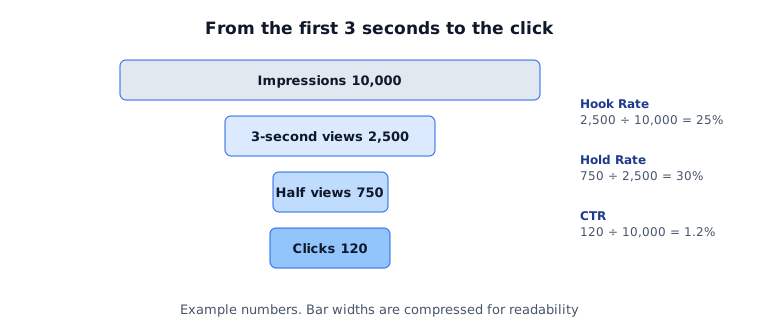
Split these three and where to fix becomes clear. High Hook Rate but weak CTR? Review the mid-message, CTA and consistency with the hook’s promise. Those metrics alone do not establish the cause. Low Hook Rate itself? Fix the opening frame. Lump it as "the creative's bad" and you'll never know what to change.
Once the hook hypothesis is set, ad creative testing covers how many to run on what budget, and ad creative performance analysis covers what actually drove the result afterwards.
These Hook and Hold Rates are operational definitions used here, not universal platform standards. For videos shorter than six seconds, halfway precedes three seconds, so this Hold Rate is not a retention proportion. Compare matching durations and counting rules.
Use the combination to pick what to fix
Read the three metrics separately and you tend to conclude that everything is a bit weak. Read them in order from the top, and fix the first stage that comes out low.
| Hook Rate | Hold Rate | CTR | Fix first |
|---|---|---|---|
| Low | Opening frame: a face, a large caption, colour contrast | ||
| High | Low | What follows the first 3 seconds: does it keep the hook's promise? | |
| High | High | Low | CTA and offer: is there a clear reason to act now? |
| High | High | High | After the click: is the store or landing page leaking? |
Judge high and low against other creatives of the same length in the same account. Comparing with platform averages mixes in placement and audience differences. For leaks after the click, continue with conversion rate improvement.
Limits of this approach
Run the same hook too long and creative fatigue may lower CTR, but elapsed days alone do not establish fatigue. One winning pattern doesn't mean milking it for weeks — build several variations of the same concept and rotate them regularly. The hook isn't a one-time hit; it's a game of constant renewal.