If you want to lift conversion rate but don't know where to start, draw the funnel first. One biggest-leaking stage usually creates most of the loss. Plugging that one first is the order. This combines our former CVR guide and funnel analysis into one diagnose-to-test workflow.
First, make the denominator in CVR explicit across the team. The same conversion count produces a different rate when the denominator is clicks, installs, or sessions. If that definition is not fixed, the diagnosis below is not comparable.
A low conversion rate is decided at one funnel stage
An app marketing funnel usually goes:
Impression → Click → Install → Signup → Purchase
Look at the pass-through rate (conversion) between each stage. Absolute numbers alone hide everything under impressions (which is why you plot on a log scale). What matters is "what share moved from the prior stage."
For example:
- Impression → click 2% (CTR)
- Click → install 40%
- Install → signup 25%
- Signup → purchase 8%
What stands out here is install → signup at 25%. Of clickers, 40% install, but only 25% of those sign up — the other 75% have no recorded signup in the chosen window. Check delays, tracking gaps, and alternate paths; this rate alone does not establish the biggest improvement opportunity.
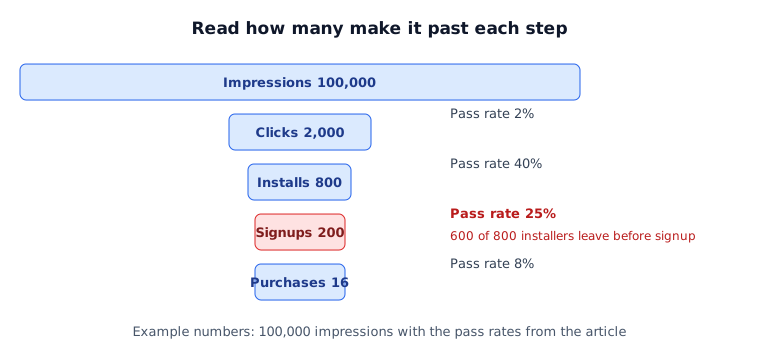
Conversion rate priority — value at stake, not the lowest rate
There's a trap: the lowest pass-through stage isn't always priority one.
Do not classify a 2% CTR as normal or unfixable. Estimate final conversions from feasible rate improvement × people reaching the stage × downstream conversion, and account for implementation cost. Lift the pass-through even slightly at a stage many users have already reached, and the absolute conversion count jumps.
So a funnel needs both "stage conversion rate" and "absolute people passing through that stage" to yield priorities.
Found the leak? — four checks when CVR won't rise
Finding the stage is where it really starts. Especially for post-click stages (landing, signup, purchase), run these four in order.
Do the ad and landing page make the same promise? If the ad says "50% off" and the landing page doesn't, the user thinks "misled?" and leaves. The ad's message and visuals have to carry into the landing page's first screen within three seconds (message match).
How many frictions are there? Too many form fields, a complex checkout, slow loading, long onboarding. Count the steps to conversion and cut where drop-off is biggest. Don't try to fix everything by gut.
Did the right person even show up? A low conversion rate may be the wrong users, not the landing page. Clickbait that forces CTR up drags in uninterested clicks and lowers conversion. No landing-page fix rescues that.
Is the offer itself strong enough? If the message matches, the path is short, and traffic is qualified, the reason to act may simply be weak. A shorter trial than competitors, an ordinary first-purchase incentive, or unclear pricing are product-and-pricing problems, not landing-page polish problems. Name them clearly and bring the right team in.
Validate each change with an A/B test
Landing A vs B, five form fields vs three, or two offer messages: change one thing at a time and verify it with an A/B test. Change several things because they "feel better" and you cannot tell improvement from regression or identify the cause.
- Wait for enough sample. A handful of conversions can reverse the next day.
- Do not peek and stop early. Ending a test at its first good-looking moment turns random variation into apparent lift.
- Read the rate with absolute conversions. Narrowing targeting can make CVR prettier while reducing total conversion volume.
CVR (fraction from 0 to 1) × denominator count = conversions
Make the final call with cost per conversion (CPA), revenue, and LTV, not the ratio alone. CVR is a checkpoint; the goal is profitable conversions.
Look at it over time, too
Read one snapshot of the funnel and you shrug "guess it's always been like this." Look at which stage dropped sharply starting when to catch causes. If signup conversion fell off last week, you can trace what changed then (a signup-flow change? a tracking issue?).
The operations dashboard's funnel tab gives you stages by basis (install/signup), an absolute↔conversion toggle, time-series drop detection, and segment ranking via CSV upload or Google Sheet connection. Where public-sheet import is enabled, use the fetch-latest button to refresh; it is not automatic synchronization.
If CPA and ROAS worsened alongside conversion rate, rule out measurement, channel, and mix first in ad performance drop; for the order to read the metrics in, see performance marketing metrics. Which analysis your data can support is in marketing data analysis, and users not staying after signup is retention cohort analysis.
Limits of this approach
Funnel conversion shows correlation, not proven causation. Before declaring "the signup stage is low, so the signup flow is the problem," also suspect traffic quality (did the wrong target come in?). The funnel is a map for deciding what to test first, not proof of the cause.